Professional Management System
Full stack system for managing professionals and contacts
A full stack system for managing professionals and contacts, combining a Next.js interface, Spring Boot backend, authentication, persistence, and a production-ready environment.
Overview
The project in perspective.
Professional Management System is a full stack application that organizes professional and contact registration and lookup through an integrated frontend, backend, and database experience.
- Objective
- Build a reliable flow for creating, finding, updating, and deleting records without duplication or inconsistent data.
- Context
- The project was developed as a complete organizational system, bringing together authentication, business rules, persistence, backend documentation, and an operation-focused interface.
- Project type
- Full stack system
- Role
- Full stack architecture and development
- Status
- Completed
- Year
- 2026
01
What this project demonstrates
Full stack architecture
A clear separation between interface, business rules, and persistence keeps the solution cohesive and easy to evolve.
Protected authentication
A JWT-based access flow restricts the administrative area to authorized users.
Domain modeling
Professionals and contacts are organized with well-defined relationships, validations, and business rules.
Docker environment
A containerized setup makes system execution more reproducible across environments.
Quality and CI/CD
Documented contracts, validations, and a structure ready to expand automated testing and continuous integration.
Production readiness
Layered organization and separate configuration support maintenance, delivery, and continuous evolution.
02
My role
Solution architecture
Defined the integration between frontend, backend, database, and the responsibility boundaries of each layer.
Interface development
Built authentication, dashboard, listing, and registration screens with clear user flows.
Backend and business rules
Implemented endpoints, validations, DTOs, and consistent application responses.
Persistence and documentation
Modeled relational data in PostgreSQL and organized the API for documentation and ongoing maintenance.
03
Features
User authentication
Credential and JWT-protected access for the system's internal flows.
Operational dashboard
An initial overview that guides navigation and brings together important system information.
Professional management
List, search, create, update, and delete professional records.
Contact management
Professional-contact relationships keep information organized.
Validation and consistent responses
API rules reduce invalid data and make integration more predictable.
Endpoint documentation
A foundation for consulting and testing the resources exposed by the REST API.
04
Gallery
Interfaces and visual records that help explain the project's experience and primary flows.
01
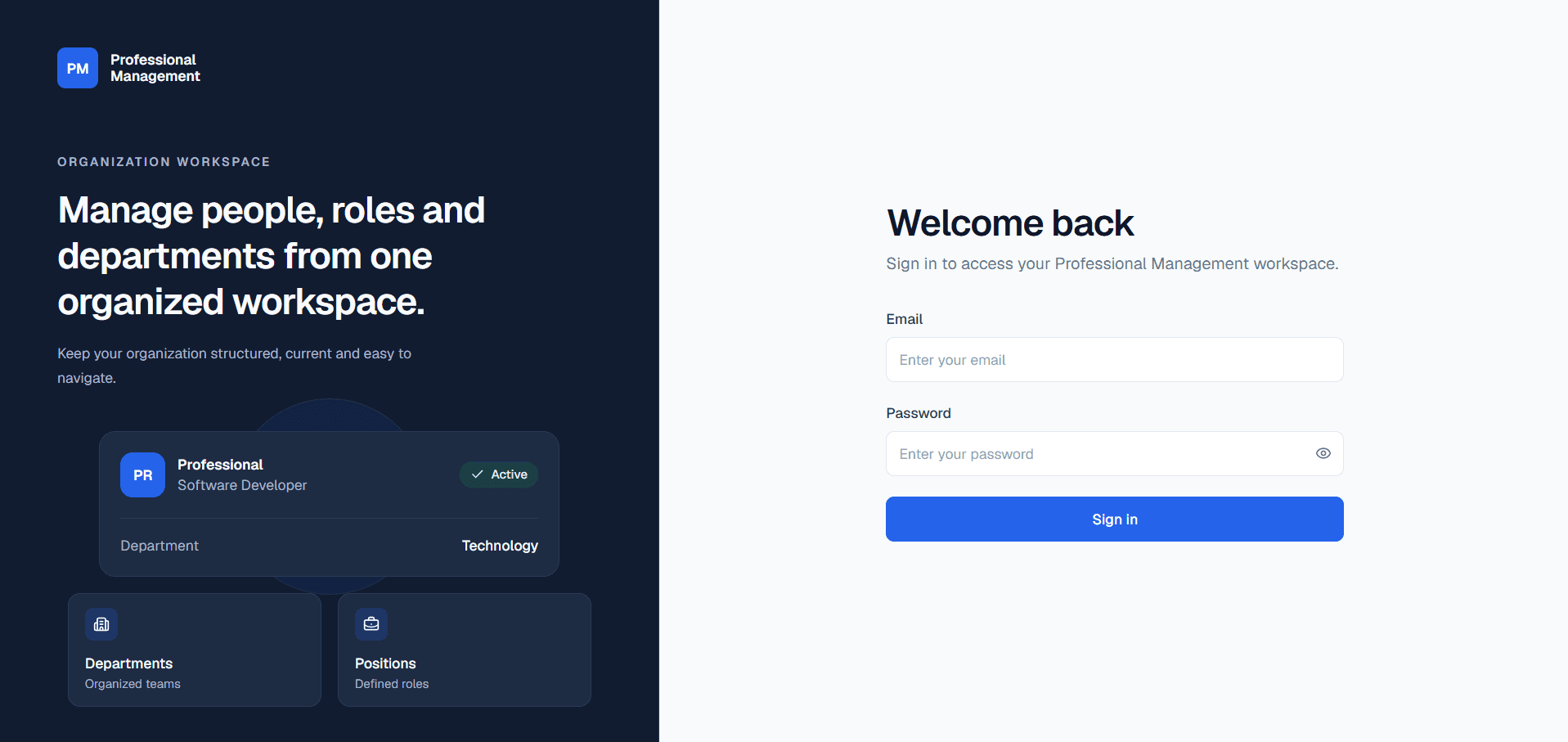
Login
A credential-based access flow into the system's administrative area.
Objective: Demonstrates authentication and protected access before navigating internal resources.
02
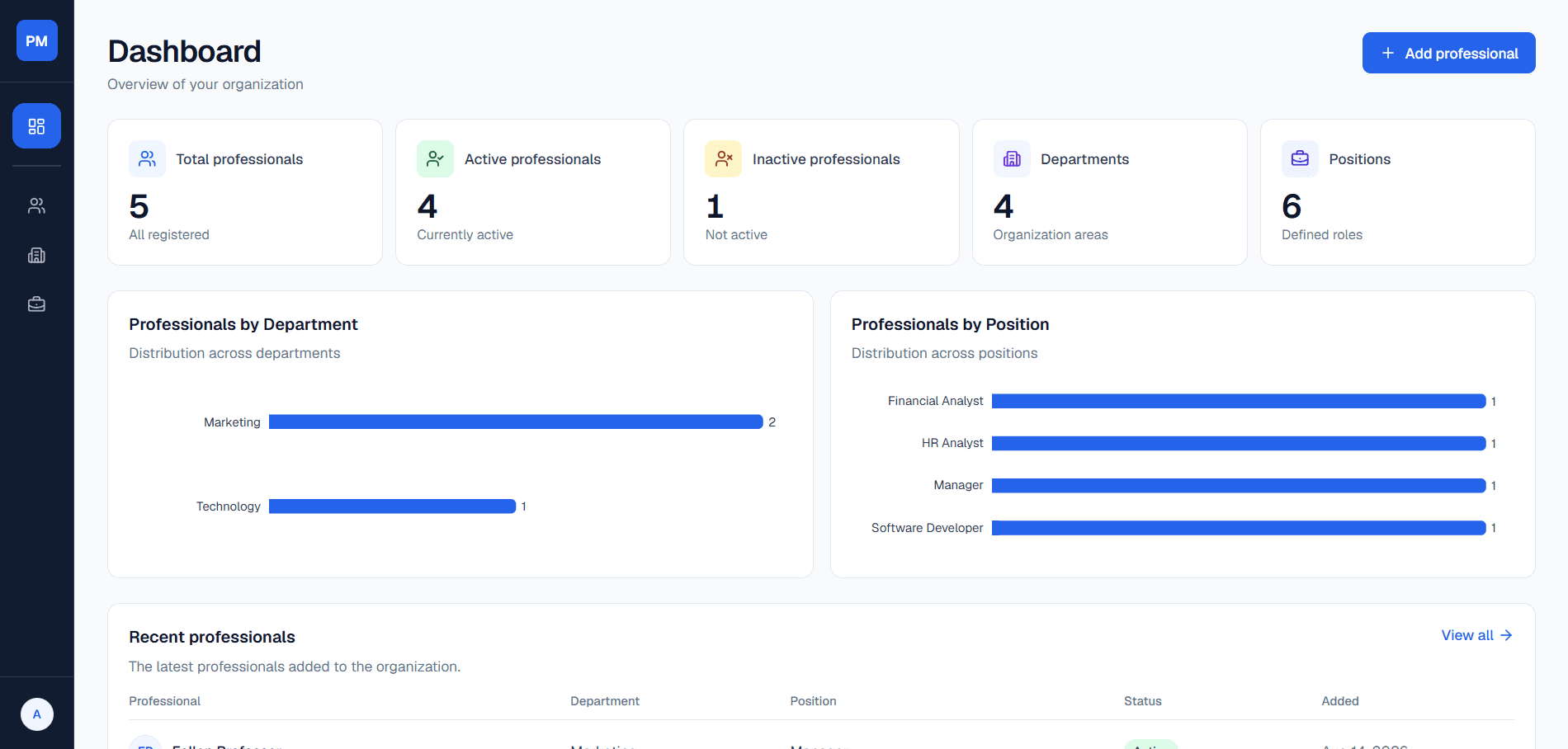
Dashboard
A consolidated view of totals, professional status, departments, roles, and recent records.
Objective: Demonstrates how organizational indicators are grouped to support an initial view of operations.
03
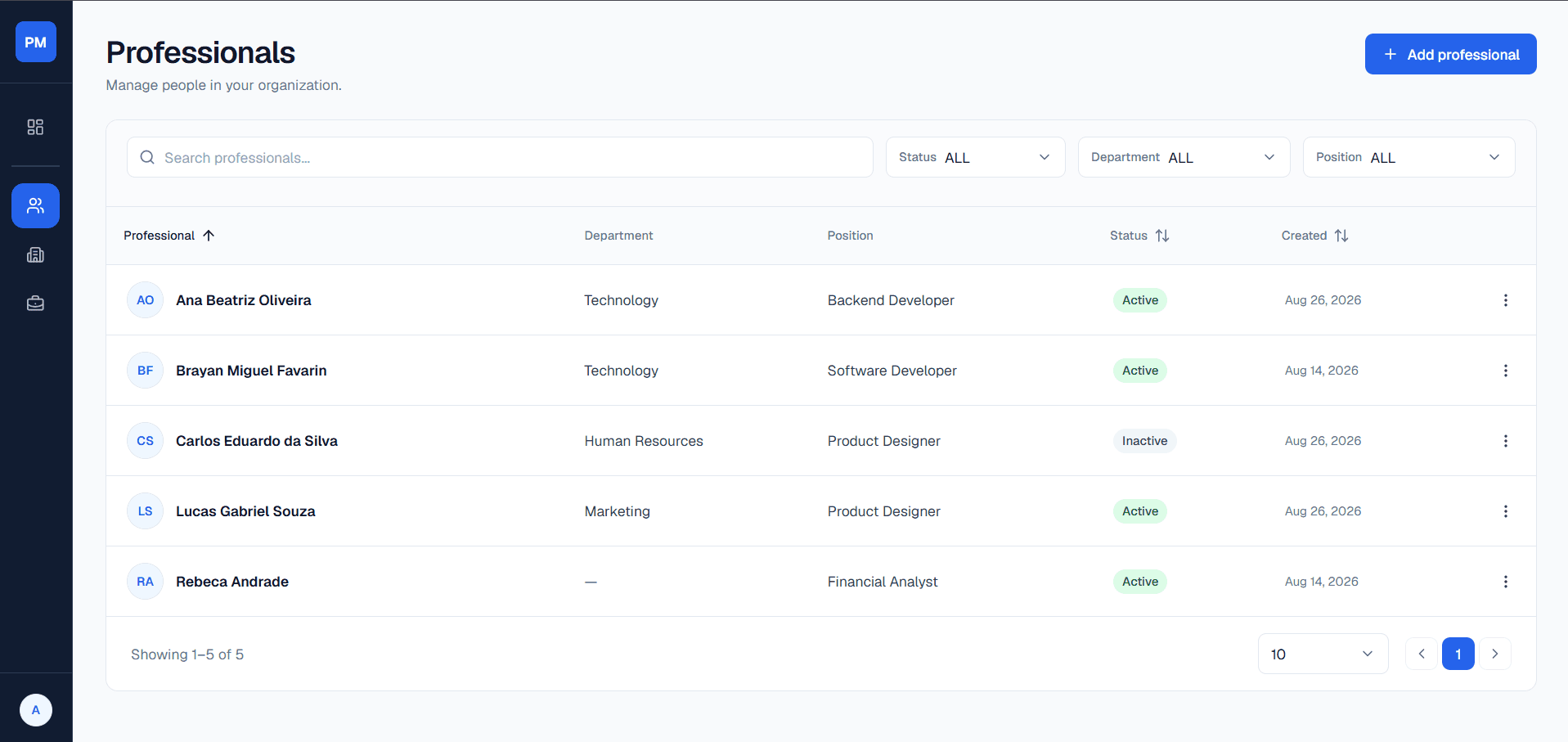
Professional list
A table with search, filters for status, department, and role, ordering, and pagination.
Objective: Demonstrates scalable professional management for easier lookup, location, and status tracking.
04
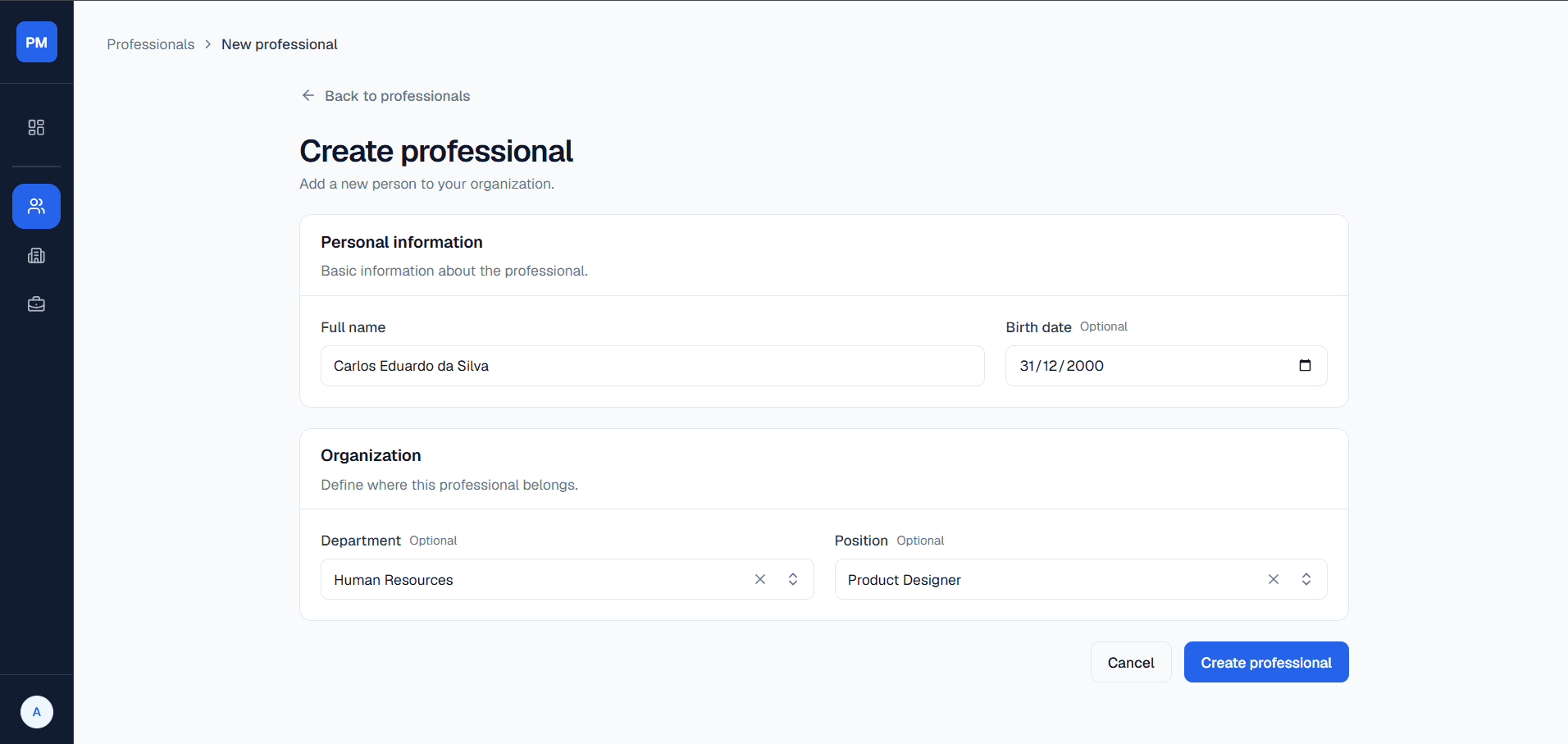
Create professional
A form organized around personal data and organizational placement to register a new professional.
Objective: Demonstrates a clear creation flow that guides input and applies domain validation rules.
05
Architecture
Next.js
The system's interface, navigation, and user experience.
Spring Boot
REST API, business rules, authentication, and data access.
PostgreSQL
Relational persistence for professionals, contacts, and application data.
Supporting elements
- JWT
- Docker
- CI/CD
- Testing
- Deployment
06
Technical stack
Frontend
- Next.js
- React
- TypeScript
- Tailwind CSS
Backend
- Java
- Spring Boot
- Spring Data JPA
- REST API
Database
- PostgreSQL
Infrastructure
- Docker
- Docker Compose
- JWT
- Deployment preparation
Quality
- Swagger / OpenAPI
- Validation
- Error handling
- Testing preparation
07
Technical decisions
Clear layers
Separation between controller, service, repository, entities, and DTOs keeps responsibilities clear.
DTOs at API boundaries
Transfer objects prevent coupling between the persistence model and public contracts.
JWT-based authentication
Tokens protect internal flows without exposing sensitive data in the interface.
Reproducible environment
Docker provides a more predictable local setup and supports future deployment evolution.
08
Learnings
- Integrating frontend, backend, and database into a single application.
- Modeling entity relationships and organizing business rules.
- Building REST APIs with clearer contracts, validation, and error handling.
- Planning a solution ready for documentation, testing, and continuous delivery.
09
Result
The result is a complete full stack system for professional management, with frontend, backend, authentication, persistence, and a Docker environment ready for maintenance and production.
- Frontend integrated with the backend
- Relational persistence with PostgreSQL
- Authentication and data management flows
- Docker environment ready for evolution and production
10
Links
Explore the public resources available to learn more about the project.
Next step
Let's build something together.
I am open to professional opportunities, projects, and conversations about software development.
Get in touch